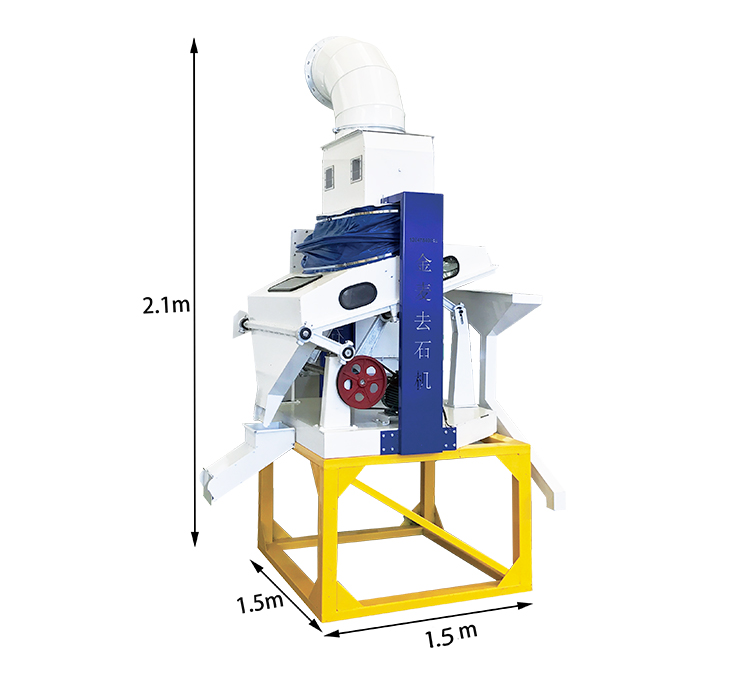
The uneven vibration of the stone removal machine is mainly caused by three major factors: improper equipment parameter settings, mechanical structural failures, and loose or worn components. The specific reasons and analysis are as follows:
1、 Improper device parameter settings
1. Amplitude and frequency imbalance
Excessive amplitude (over 5.5mm): causes the material to jump violently, disrupts the automatic grading, and mixes stones with grains.
High frequency: The material moves too fast, the material layer thickens, and it affects the separation efficiency.
Too small amplitude (less than 3.5mm): The material moves slowly and the material layer is too thick, which also reduces the separation efficiency.
Solution: Adjust the weight block of the vibration motor to maintain the amplitude within the range of 3.5-5mm; The frequency generally does not need to be adjusted, but it is necessary to ensure that the speed of the eccentric transmission stone removal machine meets the requirements.
2. Deviation of throwing angle and inclination angle
Excessive throwing angle (over 35 °): The material is prone to jumping off the screen surface, which is not conducive to the upward movement of the stones.
Too small throwing angle (below 30 °): It is difficult to move stones up side by side, which affects the efficiency of stone removal.
Excessive inclination angle of the screen surface (over 10 °): The material flows too quickly, and the stones are discharged before fully contacting the screen surface.
The inclination angle of the screen surface is too small (less than 5 °): material accumulation and excessive load on the screen surface.
Solution: Adjust the angle between the vibration direction of the screen body and the screen surface (throwing angle) to maintain it at 30-35 °; By adjusting the height of the support rod at the front of the screen body, the inclination angle is maintained at around 7 °.
2、 Mechanical structural failure
1. The vibration motor is not synchronized
The two eccentricities of the double eccentric transmission stone removal machine are not synchronized, resulting in irregular movement trajectory of the screen body and chaotic vibration.
The vibration direction of the two vibration motors is incorrect: the power supply was not reconnected according to the direction indicator, resulting in incorrect vibration direction.
Solution: Correct the positions of the two eccentricities to synchronize them; Reconnect the power supply according to the direction indicator, ensuring that the vibration direction of the two vibration motors is consistent.
2. Supporting structural issues
Inconsistent specifications of suspension rods or struts: The length or installation slope of the four suspension rods are different, causing the movement trajectory of the screen body to deviate.
Spring damage: Rubber springs aging or breaking, affecting amplitude stability.
Solution: Correct the specifications and installation slope of the suspension rod or pole; Replace the damaged spring.
3. Transmission component malfunction
Loose or worn pulleys or couplings: causing machine vibration and unstable movement of the screen body.
Bearing damage: Rolling bearings or rubber bearings are damaged, causing bouncing and twisting phenomena.
Solution: Tighten or replace the pulley and coupling; Replace damaged bearings.
3、 Loose or worn components
1. Loose connecting components
Loose motor lock nut: causing displacement of the vibration motor position, affecting the vibration effect.
The difference in vibration angle between the front and rear of the screen body is too large: adjust the vibration angle, and the degree difference should not exceed 5 °.
Solution: Tighten the motor locking nut; Adjust the vibration angle of the screen body before and after.
2. Wear or blockage of the screen surface
Screen surface damage: causing material leakage and affecting the stone removal effect.
Blockage of sieve holes: prevents materials from passing through normally and reduces screening efficiency.
Severe wear on the sieve surface: The size of the sieve holes increases, resulting in incomplete separation of stones.
Solution: Replace the damaged screen surface; Clean the clogged sieve holes; Regularly check the wear of the screen surface and replace it in a timely manner.