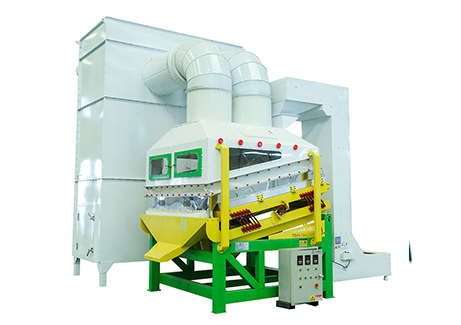
When selecting the screening material for the stone removal machine based on the type of grain, targeted matching should be carried out according to the grain particle size, hardness, humidity, and impurity characteristics. The specific principles are as follows:
1、 Select sieve structure based on grain size
Fine grained grains (such as millet and rapeseed)
It is advisable to use woven screen mesh. Its sieve holes are fine and diverse in shape (such as round or square), which can effectively intercept small stones while allowing grains to pass through. The opening rate of woven screen mesh is high, suitable for processing materials with small particle size differences, which can avoid small impurities blocking the screen holes and ensure screening efficiency.
Coarse grained grains (such as corn, soybeans)
Prioritize the use of perforated screen plates. Its sieve holes are large and regular, capable of withstanding the impact and wear of coarse-grained materials. The perforated sieve plate has high structural strength and is not easily deformed, making it suitable for processing grains with larger particle sizes. It can prevent large particles from getting stuck in the sieve holes and affecting the screening effect.
2、 Choose wear-resistant materials based on grain hardness
Hard grains (such as hard wheat and ores with high stone content)
Alloy steel or polyurethane screen surface should be selected. Alloy steel has high hardness and can withstand the friction and impact of hard materials, extending the service life of the screen surface; Polyurethane sieve surface has good elasticity, can buffer material impact force, reduce wear, and the sieve holes are not easily blocked, suitable for handling high hardness and high wear materials.
Soft grains (such as rice, peanuts)
You can choose between ordinary stainless steel or carbon steel screen surfaces. This type of material not only meets the basic requirements for separating stones, but also has good economic efficiency. Soft grains have less wear on the screen surface and do not require special wear-resistant materials. Ordinary stainless steel or carbon steel can ensure the screening effect.
3、 Select anti-corrosion materials based on grain humidity
Wet grains (such as freshly harvested rice, wet sand)
Stainless steel screen surface should be selected. Stainless steel has good corrosion resistance and can resist the erosion of moisture in humid environments and materials, avoiding rusting of the screen surface and affecting performance. At the same time, the stainless steel screen surface has high smoothness, which helps wet materials slide and reduces adhesion and blockage.
Dry grains (such as dry wheat, dry mung beans)
Materials can be selected based on other characteristics. If the particle size of the material is fine, a woven sieve can be used; If the particle size is coarse, ordinary carbon steel perforated sieve plate can meet the requirements. Dry materials have lower requirements for the corrosion resistance of the sieve surface, so the material selection range is wider.
4、 Select special materials based on impurity characteristics
Containing corrosive impurities (such as acidic or alkaline components in chemical raw materials)
It is necessary to choose materials with strong corrosion resistance, such as stainless steel or polytetrafluoroethylene. Stainless steel can resist general acid-base corrosion, while polytetrafluoroethylene has excellent chemical stability and can withstand corrosion from various strong acids, strong bases, and organic solvents, avoiding corrosion damage to the screen surface and ensuring the normal operation of the stone removal machine.